Fitness
CTLThe slow average of your daily load. Months of base and build raise it; it barely moves week to week.
58Today
57Race day

Three numbers from the Performance Manager model of Allen, Coggan & McGregor, computed from your own rides: what each means, where the load comes from, and how form brings you to your event.
iOS 26+ · iPhone · Free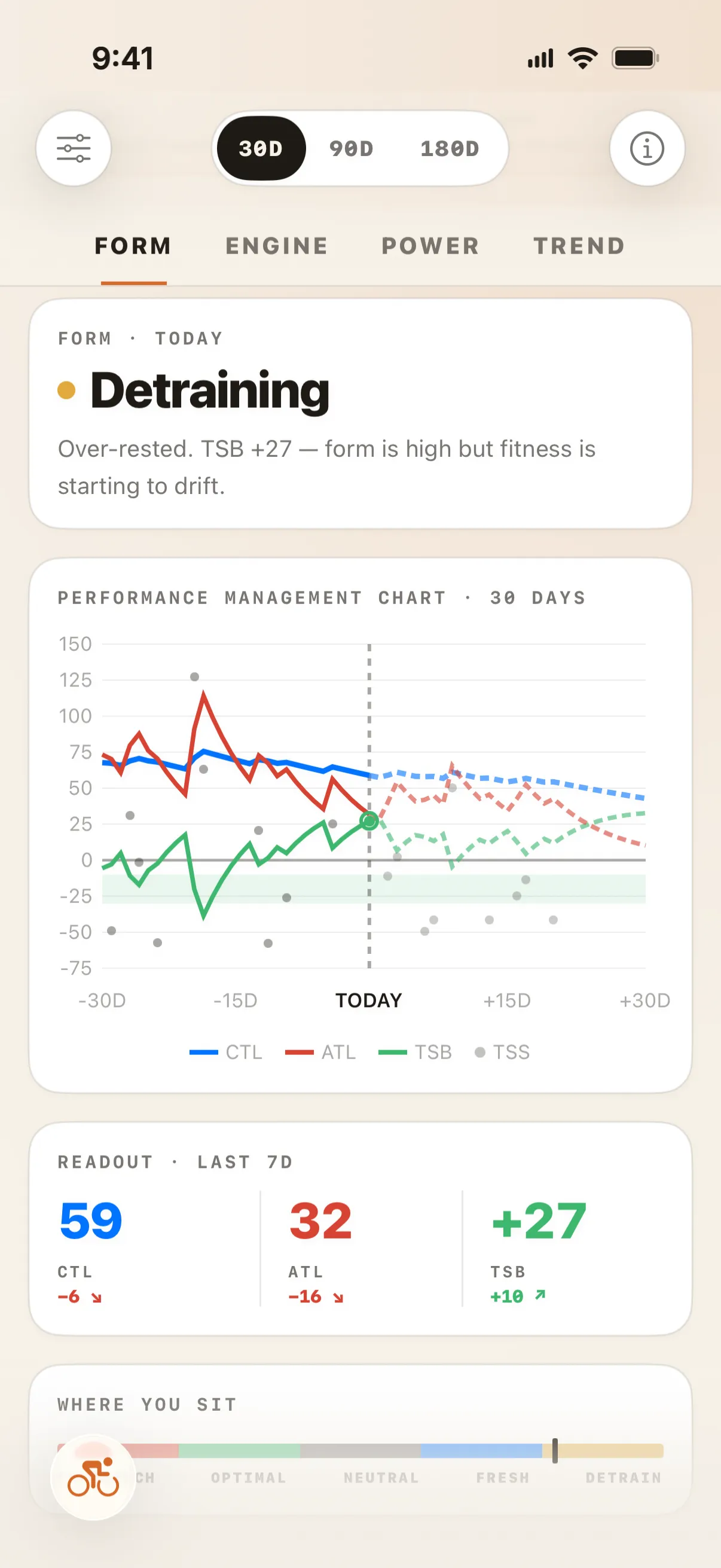
All three come from the same daily load, your TSS, averaged over two different spans.
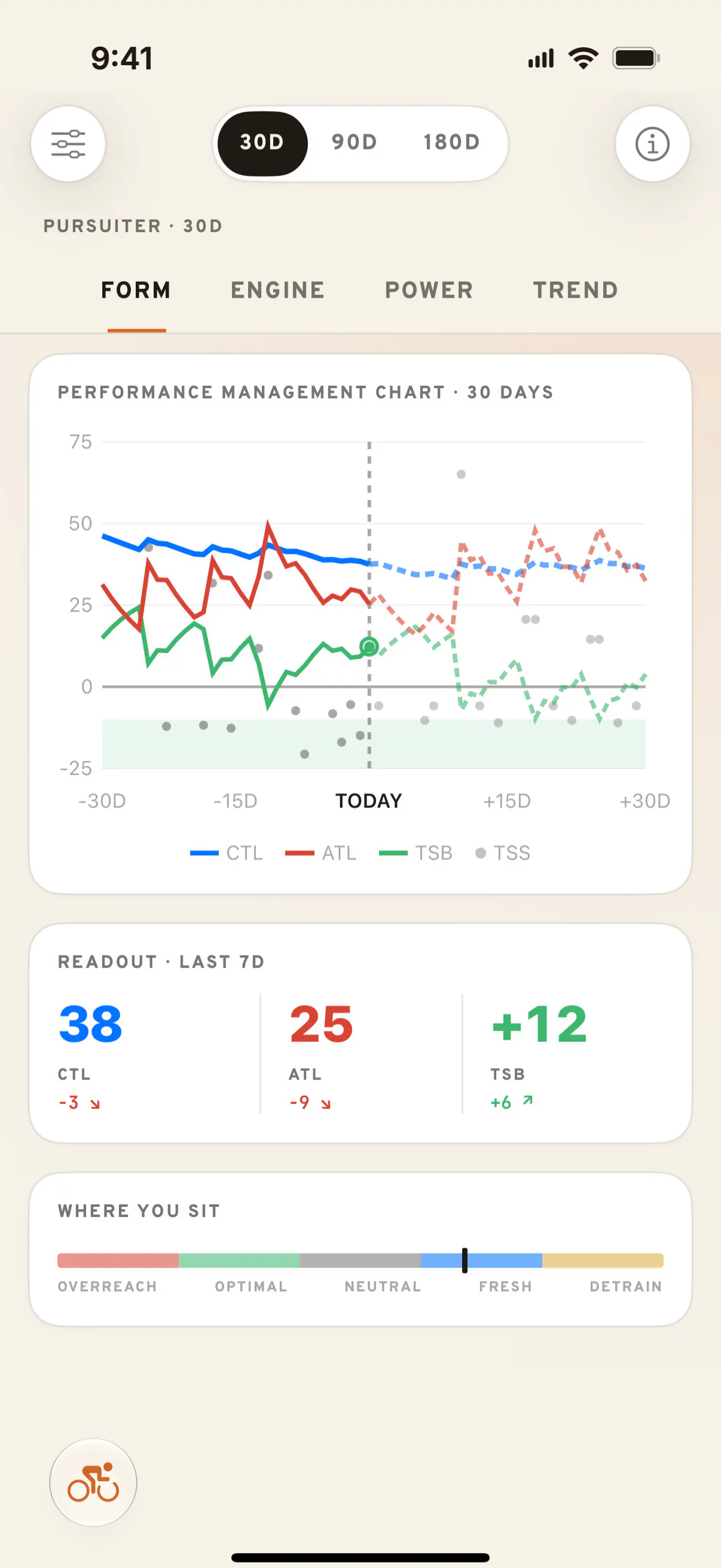
Performance Management ChartIn-app view
Where you sit
The slow average of your daily load. Months of base and build raise it; it barely moves week to week.
The fast average of the same load. It climbs with every hard block and clears within days of easing off.
Fitness minus fatigue: how much of your fitness you can use today. Negative in a heavy block, positive when you arrive fresh.
From Strava or a Hammerhead Karoo, the only two sources of rides.
From power when the ride has it. Without a power meter, from heart rate against your LTHR (hrTSS), so the ride still counts.
Fitness, fatigue and form update from each day’s TSS with the standard Performance Manager maths.
One honest limit: on long rides, heart-rate load reads high, because cardiac drift raises heart rate at the same work (Coyle & González-Alonso, 2001).
On Elite, the plan works backwards from your race date and steers form on purpose.
| In the app | Plan |
|---|---|
| Rides imported from Strava or a Hammerhead Karoo | Free |
| Fitness, fatigue and form (CTL, ATL, TSB) | Pro |
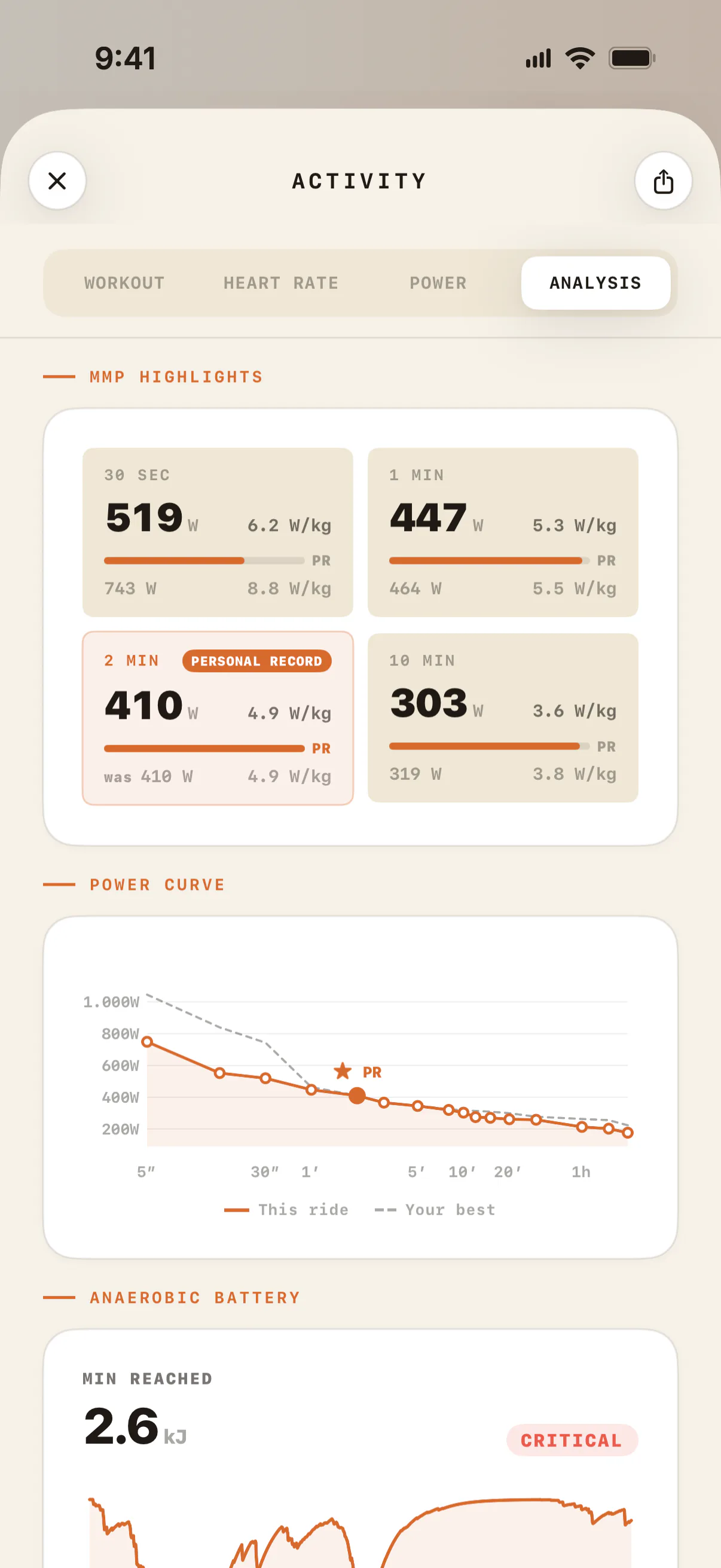
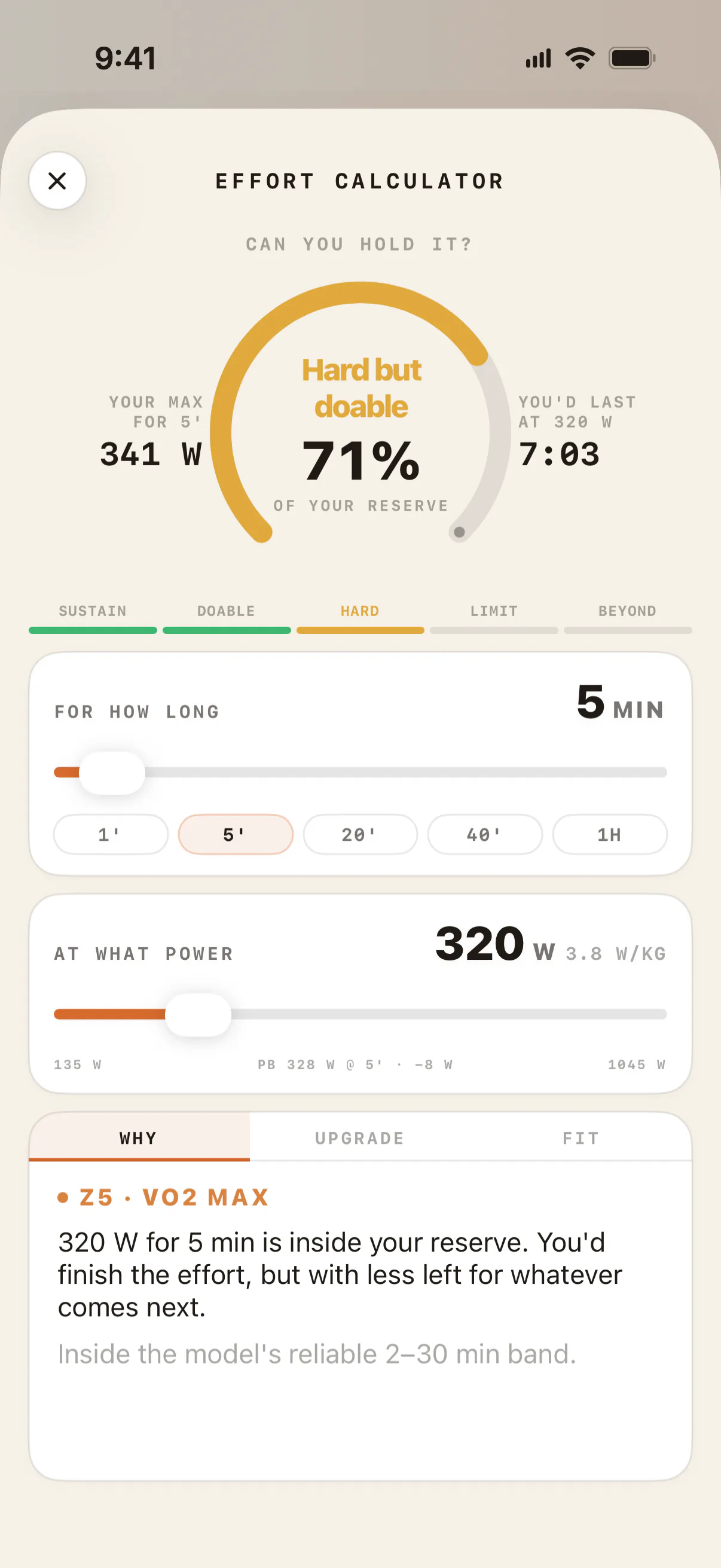
| Detailed ride analysis, eFTP, W′bal, the power curve and the effort calculator | Pro |
| Notifications for a new eFTP and for peak form | Pro |
| Today’s session, cut from the week’s load budget | Elite |
| Periodisation, peak and taper to your event | Elite |
Riding by heart rate? The Training tab shows the PMC built from your heart rate; eFTP, W′ and the power curve need power data. Prices, with the storefront and VAT caveat, are on the pricing page →
No. A ride without power still counts: its load is computed from heart rate, and a heart-rate rider's Training tab shows the PMC built from it. eFTP, critical power, W′ and the power curve do need power data. Since app 1.7.0 every structured session can also be ridden by heart rate; the full session, in watts or in heart rate, is Elite.
It is the same Performance Manager model and the same maths, applied to your own rides, so it compares with any tool built on that model. Summit does not claim a better CTL, only a better use of it.
Yes. Fitness, fatigue and form are Pro, with the ride analysis, eFTP, W′bal, the power curve and the effort calculator. Elite adds the plan that acts on them: the session, the periodisation and the taper to your event.
On Elite, the week keeps its load. What you missed is spread across the days still open, and a missed key session moves to a later training day of the same week. One miss re-plans this week and the next, not your season.
No model decides anything. Fitness, fatigue and form are computed from your own TSS with the Performance Manager model of Allen, Coggan & McGregor, which the app cites with the rest of its sources. How Summit combines its models is not published, but every number traces back to a rule.
Download Summit and connect Strava or your Hammerhead Karoo. Fitness, fatigue and form are Pro, the plan built on them is Elite, and your recovery score and sleep readings are free.
 iOS 26+ · iPhone · Free