

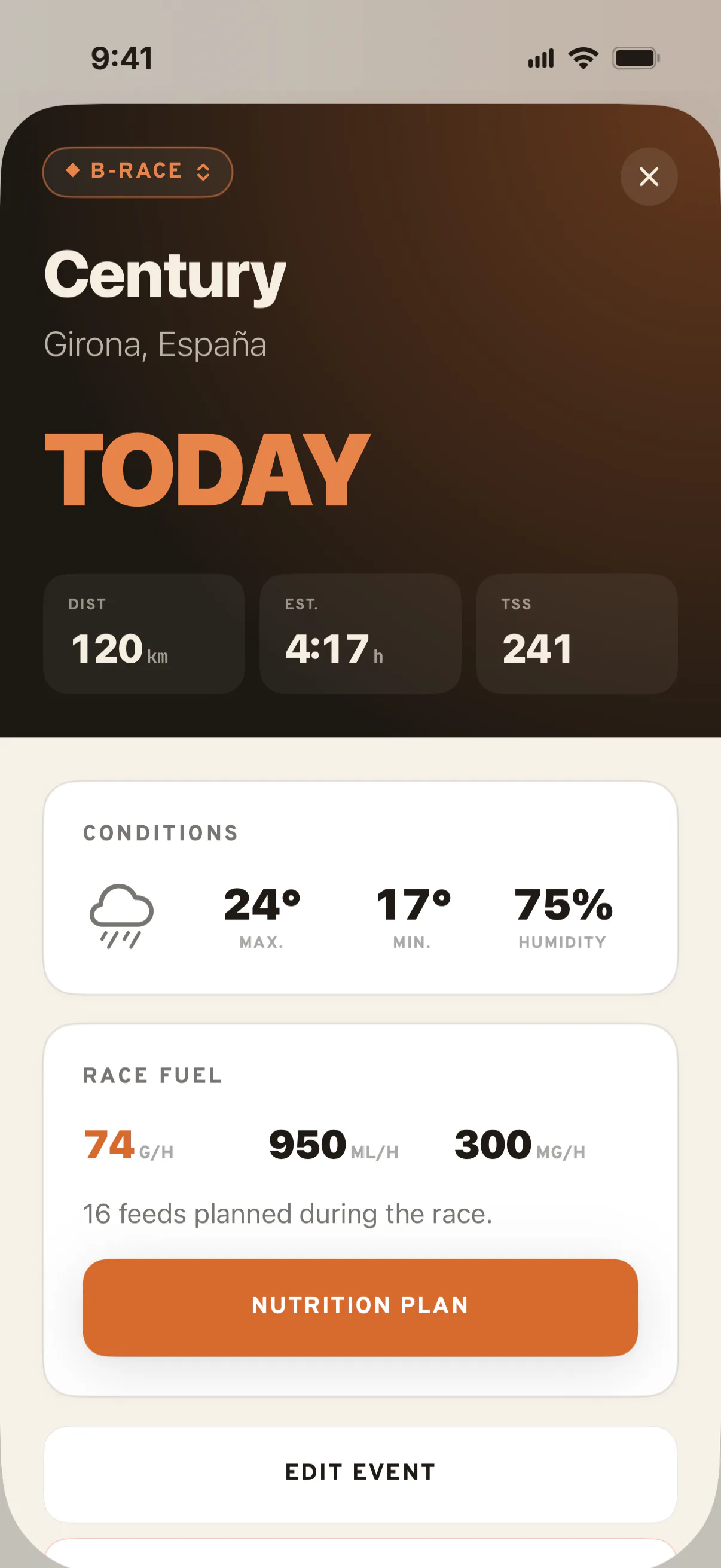
The race: distance, estimated time and load, the forecast high, low and humidity, and the race fuel targets per hour

From the calendar to the start line.

You add the event once. Open the plan before race day and Summit builds it from the event, saved for race morning.

  1. Event on your calendarIts duration, and the load Summit estimates for it, which sets the intensity
  2. Plan openedCarbs, fluid and sodium per hour, then feed by feed from the products on your shelf
  3. Race morningA notification at 06:00 with your carbs per hour, once a plan has been built. The plan is saved for offline use

What goes in, and what comes out.

Nothing to type on the day. Most of it comes from the event and from settings you fill in once.

What goes in

  • The event’s duration, from the event on your calendar.
  • Its intensity: taken from the event’s estimated load.
  • The day’s forecast high and humidity at the event’s location, when the event has one and the forecast reaches that day.
  • How much you sweat and how salty your sweat is: three-level choices in your nutrition settings, not a lab test.
  • Whether you are acclimated to heat.
  • How trained your gut is: beginner, trained or advanced.
  • Caffeine doses, only if you turn them on, and how sensitive you are to it. It is off by default; caffeine already in a product on your shelf is still scheduled, and the plan tells you.
  • The gels, drinks, chews, bars and real food on your shelf. With an empty shelf, the full catalogue.
What comes out

  • Carbs in g/h, fluid in mL/h and sodium in mg/h, at the top of the plan.
  • A timed schedule: when, which product, and the carbs, fluid, sodium and caffeine it carries.
  • What to carry in your pockets: how many of each product.
  • Totals, including the glucose:fructose ratio the plan actually delivers.
  • Before the start: a meal about three hours out on long events, fluid with sodium an hour out, a late snack.
  • Caffeine, if it is on: a dose before the start and, on long events, a second in the final third.
  • A recovery block for after the finish, on long events.

Your weight does not size the carbs, fluid or sodium. It sizes the caffeine, the pre-race meal and the fluid before the start: about 5 mL per kilo, an hour out.

How the three numbers move.

The shape of the model, in words. The constants behind it are not published.

Carbs
A continuous curve on duration and intensity, not a handful of fixed bands. It is capped by how trained your gut is and tapers on very long events.
Fluid
Scales with air temperature, intensity and humidity, or follows your own sweat rate.
Sodium
A share of what you lose in sweat, about 70% while you ride, and it rises in heat. The rest is made up after the finish.
Heat
From 30 °C the plan tells you to prioritise hydration and sodium and to start drinking from minute zero. From 35 °C the warning changes shape: ease the pace and cool yourself, because hydration alone stops being the answer.

The heat article works one three-hour ride through at 18 °C and at 33 °C. Read the worked example →

The schedule, read in order.

The app puts it in one line: eat this, in this order.

  1. Before the start

    The meal, the fluid with sodium and the late snack, each at its time. If caffeine is on, the first dose is here.

  2. On the bike

    Each line is a time into the race and one product, with what it carries. Lines are grouped by hour, with that hour’s carbs and fluid on top.

  3. After the finish

    On long events, a recovery block: what to take once you stop.

In the app.

Race day
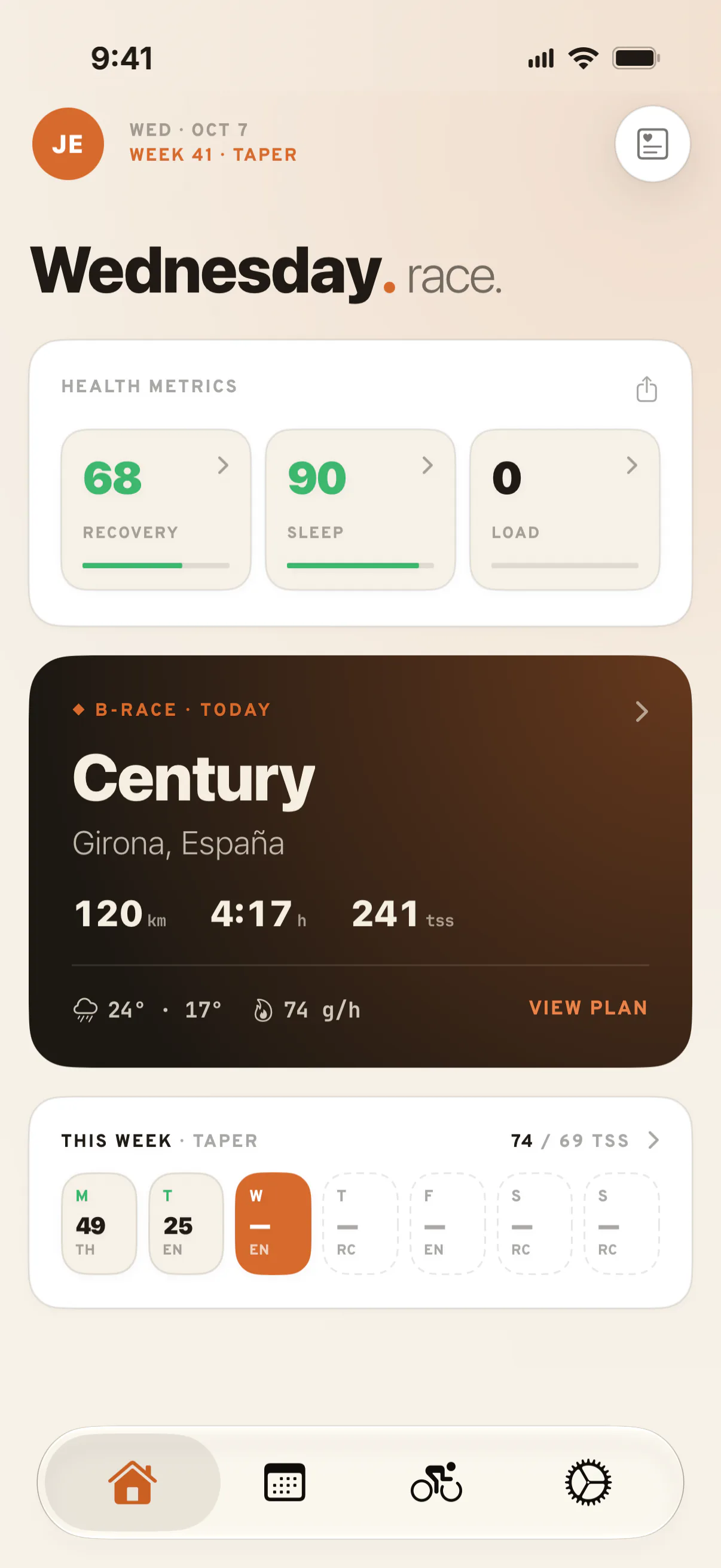
Race dayToday opens on the event and its forecast, with the plan one tap away.

What it warns you about.

Before race day, not at kilometre 80.

  • Your shelf cannot reach the target: no high-carb drink, not enough carbs, a glucose:fructose ratio it cannot build, or not enough sodium.
  • The carb target is above what a beginner-level gut handles.
  • A drink too concentrated in carbohydrate: hypertonic, slow to leave the stomach.
  • Your fluid need is above what you can absorb.
  • Heat from 30 °C, and extreme heat from 35 °C: the safety warning, to ease the pace and cool yourself.
  • Your caffeine total is too high.

What it doesn’t do.

  • A carb-loading plan for the days before. The plan starts on race morning.
  • A whole multi-day event in one plan. It plans one day, one stage.
  • Sharing or exporting the plan. It lives in the app, saved for offline use.

Daily nutrition matched to your training, with recipes and a shopping list, is in development and not part of the current App Store version. See the roadmap →

What the plan builds on.

The app lists these on the race-day screen. They are the published guidance the model starts from; none of them tested Summit’s numbers.

  • Jeukendrup A. (2014). A step towards personalized sports nutrition: carbohydrate intake during exercise. Sports Medicine, 44(S1), S25–S33. doi:10.1007/s40279-014-0148-z
  • Burke L.M., Hawley J.A., Wong S.H.S., Jeukendrup A.E. (2011). Carbohydrates for training and competition. Journal of Sports Sciences, 29(sup1), S17–S27. doi:10.1080/02640414.2011.585473
  • Thomas D.T., Erdman K.A., Burke L.M. (2016). American College of Sports Medicine Joint Position Statement: Nutrition and Athletic Performance. Medicine & Science in Sports & Exercise, 48(3), 543–568. doi:10.1249/MSS.0000000000000852
  • Viribay A. et al. (2020). Effects of 120 g/h of carbohydrates intake during a mountain marathon on exercise-induced muscle damage in elite runners. Nutrients, 12(5), 1367. doi:10.3390/nu12051367
  • Rowlands D.S. et al. (2015). Fructose–glucose composite carbohydrates and endurance performance. Sports Medicine, 45(11), 1561–1576. doi:10.1007/s40279-015-0381-0
  • Guest N.S. et al. (2021). International Society of Sports Nutrition position stand: caffeine and exercise performance. Journal of the International Society of Sports Nutrition, 18(1). doi:10.1186/s12970-020-00383-4

A plan to start from, not medical advice. Try it on a long training ride before you trust it on race day.

Questions before you start.

Is the race-day plan free?+

No. The race-day plan is Elite; on Free and Pro it shows as a locked card. Adding races and events to your calendar is free on every plan. The pricing page has the prices and their caveat.

Do I need a power meter or an FTP?+

You need an FTP or a critical power set in Summit, but not a power meter: the plan will not generate without one. If you ride without power, type an FTP yourself in Settings → Performance metrics. Summit’s structured sessions can be ridden by heart rate; this plan still needs that number to be set.

Does it use my own gels and drinks?+

Yes. It builds the schedule from the gels, drinks, chews, bars and real food on your shelf, and tells you what to carry in your pockets: how many of each. With an empty shelf it uses the full catalogue. If your shelf cannot reach the target, the plan says which part falls short.

Does it account for heat?+

Yes, when the event has a location and the forecast reaches that day. Summit reads the day’s forecast high and humidity there: fluid rises with heat and humidity, and sodium rises in heat. From 30 °C the plan tells you to prioritise hydration and sodium; from 35 °C it adds easing the pace and cooling yourself. Whether you are acclimated to heat is a setting.

Does it plan carb loading?+

No. The plan starts on race morning: a meal about three hours out on long events, then fluid and a small snack before the start. There is no carb-loading plan for the days before.

Does my weight change the numbers?+

Not the hourly ones. Carbs, fluid and sodium per hour come from the event, the forecast and your sweat. Your weight sizes the caffeine, the pre-race meal and the fluid before the start, about 5 mL per kilo.

Add the race. Ride the plan.

Download Summit and put your race on the calendar, free on every plan. On Elite, open its race-day plan before the day.

Download on the App Store iOS 26+ · iPhone · Free