
At seven in the morning the question is whether today's intervals still make sense. WHOOP, Oura and Garmin each answer it the same way: they take what the sensor measured overnight, judge it against the person who wore it, and reduce it to one score on a fixed scale.
Summit gives the same kind of answer, and it computes that score with its own engine, on your iPhone, from the data your wearable already records. This article is about why that matters more than it sounds. A recovery number is only useful to a training plan if the plan knows exactly what is inside it, and building the number is the surest way to know that.
What the market leaders got right
The single score is the right design, so it is worth looking at how the three best-known ones are built before saying anything about Summit's.
| Score | Scale | What it reads |
|---|---|---|
| WHOOP Recovery | 0–100% | Resting heart rate and HRV; blood oxygen and skin temperature on WHOOP 4.0 |
| Oura Readiness | 0–100 | Nine contributors, among them HRV balance, resting heart rate, body temperature, sleep, sleep balance, sleep regularity and the previous day's activity |
| Garmin Training Readiness | 1–100 | Last night's sleep score, recovery time, HRV status, acute load, sleep over the last three nights and stress over the last three days |
Each row from the company's own page, checked 28 October 2026: WHOOP's developer documentation, Oura's Readiness Score article and the Training Readiness page of a current Garmin manual.
Three different products share the same three ideas: many overnight signals instead of one, each read against your own history, and a single number at the end so that the decision takes a second. Oura and Garmin also attach a verdict in words to each range of their scale.
Summit's recovery score shares those ideas, with HRV first, read against your own baseline, and resting heart rate and sleep around it. It does not claim to be more accurate than any of the three, because that cannot be checked from outside, and a claim nobody can check has no place in a training decision.
Why not borrow someone else's number
Summit does not sell a sensor. You might ride with an Apple Watch, a Garmin, a WHOOP strap or an Oura ring, and the plan has to make the same decision whichever device feeds Apple Health or intervals.icu. That is the first reason it needs an engine of its own.
Scores built by different companies from different inputs are different units, so a 62 from one brand does not mean what a 62 from another means, and nothing guarantees that the same session should follow from both. Summit therefore takes the raw signals (the HRV, the night's heart rate, the sleep) and runs them through one calculator on one scale. It reads them from Apple Health, where any wearable that writes there works and the Apple Watch writes the complete set, or from intervals.icu, where a Garmin, a WHOOP and other devices sync their wellness data. Both routes end on the same scale, and that number moves the plan in the same way.
The second reason is that an imported score arrives as one number. The plan cannot see how long a history it was read against, or whether it came from a full night or half of one. Summit's own score knows both, which is what lets it stay conservative while it is still learning you, cap itself when your temperature runs high or your blood oxygen stays low, and refuse to produce a number at all when there is no fresh night to read.
The third is privacy. On the Apple Health route the score is computed on your iPhone from data that stays there, and only the resulting scores are sent so that the plan can adapt.
There is one place where Summit shows a number it did not compute. On the intervals.icu route the provider sends how long you slept but no bedtime, wake time or stages, so Summit shows your device's own sleep number, uncoloured and marked as coming through intervals.icu, and builds recovery from the signals that route does send. Inventing a sleep analysis from data it does not have would be worse than showing someone else's.
What goes into the recovery score
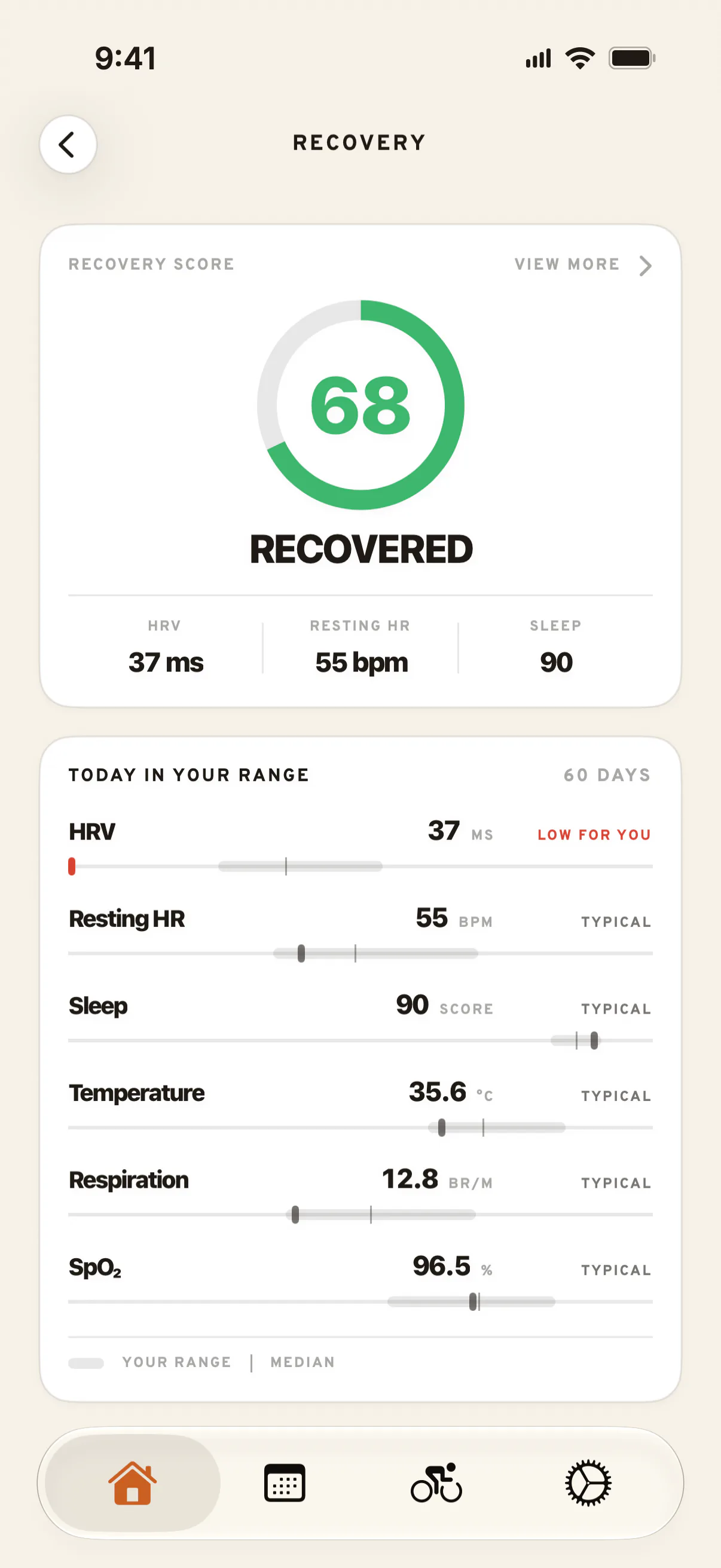
HRV, measured as RMSSD, is the main driver, and the only HRV measure Summit uses. Around it sit the average heart rate across the night, which measures the whole night rather than its lowest instant, Summit's own sleep score, and three smaller signals: respiratory rate, blood oxygen and sleeping wrist temperature. Those three carry little weight, although an elevated temperature or a blood oxygen reading that stays low can cap the score.
Every signal is judged against your own recent history with robust statistics, so a low resting heart rate means low for you. While the history is short the score stays deliberately conservative, and it opens up as your baseline matures. The approach rests on research the app cites on the screen itself: Plews and colleagues (2013) on HRV monitoring in endurance athletes, and Buchheit (2014) on monitoring training status with heart-rate measures.
The screenshot shows why a combined number is worth having. That morning the rider's HRV was low for them, while resting heart rate, sleep, temperature, breathing and blood oxygen were all typical. Read on its own, the HRV looks like a bad morning; read together with the rest, the night comes out at 68, recovered.
What the score leaves out is just as deliberate. In February 2026 Summit removed subjective inputs (jet lag, soreness, illness, injury) from the percentage, because they are not measurements. An illness flag still stops the day outright, through a separate rule.
And a sleep score of its own
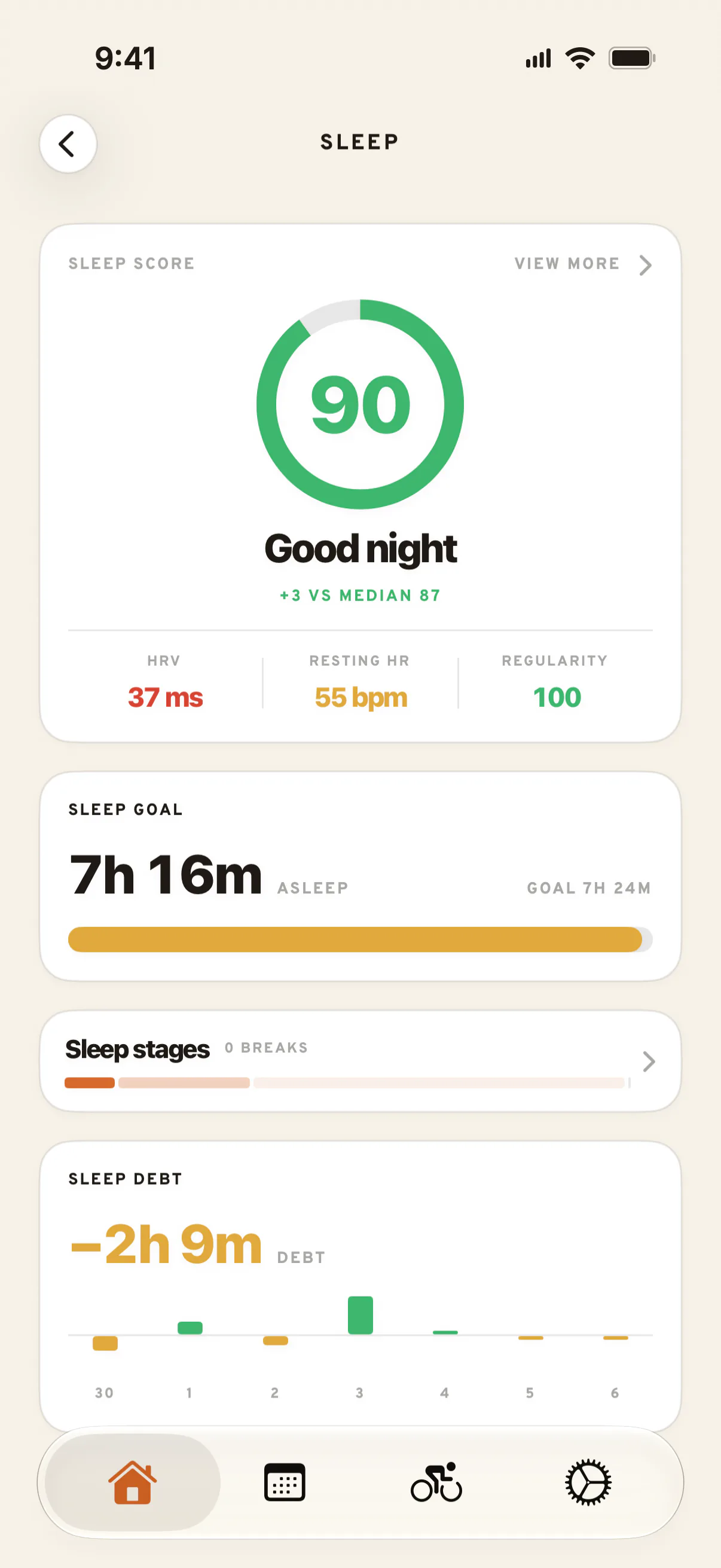
Sleep gets its own score because it answers a different question. Recovery asks whether your body can take load today, while sleep asks how well you slept, and Summit builds that second score only from behaviour: time asleep against what you need (a need that rises with your training load), efficiency, time awake in the night, deep and REM sleep, and how regular your bed and wake times are. HRV and night heart rate are measured on the same night, but they feed recovery, so the two numbers never count the same signal twice.
Next to the score you see the gap to your own median, your sleep goal against the time you slept, the stages on a real clock and the debt of the last fourteen nights. Since version 1.7.0 the deeper analysis is built around regularity, with your bed and wake times drawn against your usual window, because that is the part of the night you can change tonight. It prints no cycle count and no time to fall asleep, because the watch measures neither. The sleep section cites the expert consensus on sleep in athletes published in the British Journal of Sports Medicine (Walsh et al., 2021) and the National Sleep Foundation's recommendations on sleep duration (Hirshkowitz et al., 2015) and sleep quality (Ohayon et al., 2017).
If you want the full tour of what the morning read shows, screen by screen, it is in the guide to Summit's free recovery and sleep analysis.
Where the number goes: today's session
This is the real reason to own the engine: the same engine that wrote today's session reads the score and adjusts the session to it.
On the Apple Health route Summit recomputes recovery in the background once the night is in and adapts today's session, which can happen before you open the app. The reading maps onto a ladder of six responses, from extending the session down to complete rest, with riding it as planned, swapping the session type while keeping the duration, and soft activation only in between. Each step changes what you are asked to do on the bike.
The ladder is asymmetric on purpose, because softening a session is cheap and hardening one is not. A falling trend lowers the response unless the reading is still green and your form (TSB) shows no accumulated fatigue, in which case an isolated dip is treated as noise in the score. A rising trend only raises the response inside green, because a rebound after a bad day is a return to baseline rather than spare capacity. Climbing the ladder needs a green reading and a training phase that allows it, and by default the maintenance and transition phases never do.
When there is no reading at all, because you did not wear the watch, Summit does not estimate a value: the session is decided by your training load and your form alone.
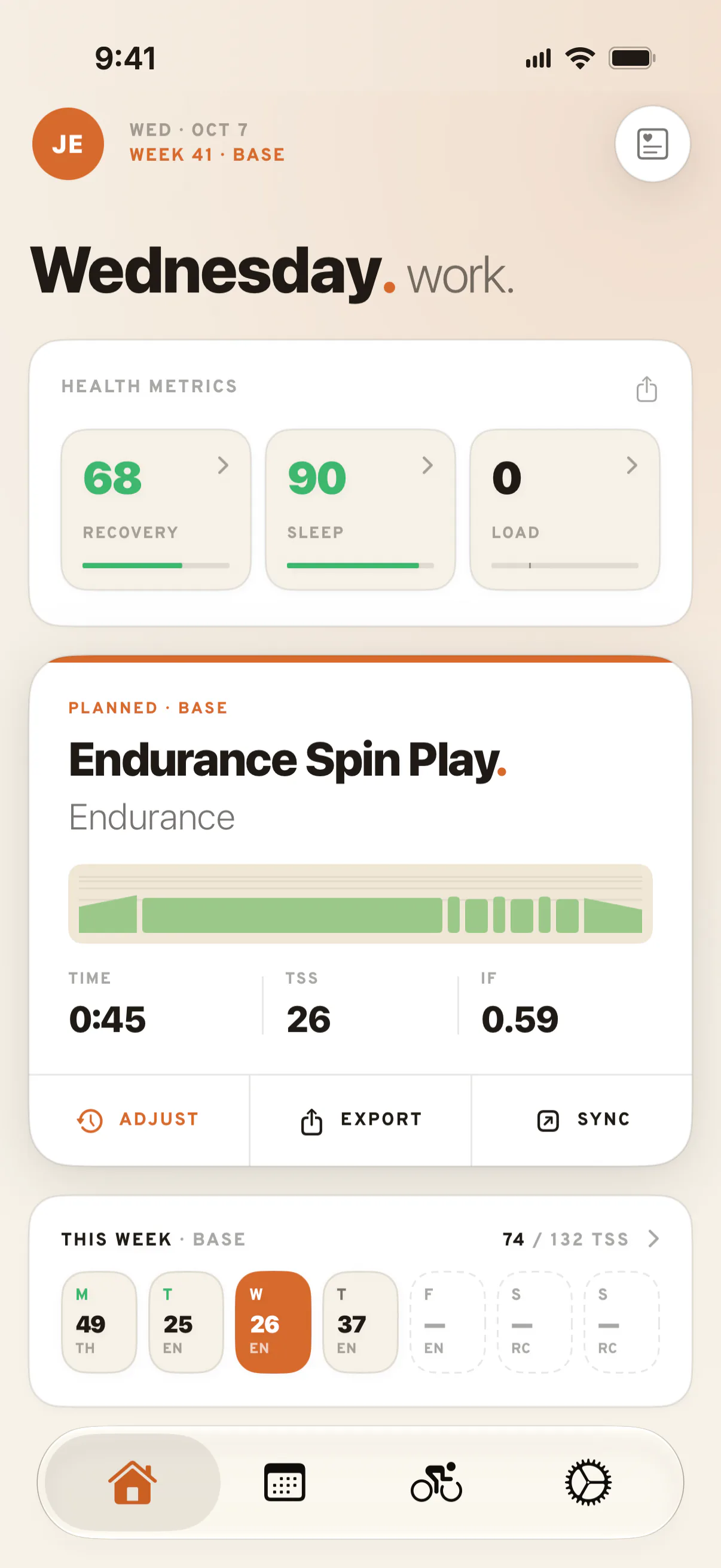
The session that moves is one day of a plan built back from your event date, through the phase, the week's load and the day. That chain is what gives the adjustment its value, because the plan around the recovery number turns it into a decision for the event you are training for.
What it will not do
- It will not show a number it does not have. With no fresh night there is no score, and yesterday's is not carried over.
- It will not diagnose anything. The score is guidance for training, and the app says so: it does not replace the advice of a healthcare professional or a certified coach.
- It will not publish its weights. What it reads and the research it reads it against are public; how each signal is weighted is not. Auditable does not mean replicable.
- It will not hand the decision to a model. The score and the adjustment are deterministic, and no AI model decides anything.
What is free
The recovery score, the sleep score and its analysis, the recovery trend and the widgets are free, permanently, with no trial running out. So is the intervals.icu connection that brings in wellness data from a Garmin or a WHOOP. The plan that adapts to the score, with the full session and its targets, is part of Elite. What each plan includes is on the pricing page.
Frequently asked questions
Is Summit's recovery score the same as WHOOP's or Oura's?
No. It shares the idea of reading overnight signals against your own baseline, with HRV first, but Summit computes it with its own engine from the raw signals, and it does not claim to be more accurate than either.
Can I use it with a Garmin or a WHOOP?
Yes, through intervals.icu. Sync the device to intervals.icu and connect it in Summit, which is free on every plan. HRV, resting heart rate, respiratory rate and SpO2 then feed the same calculator, and on that route Summit shows your device's sleep number instead of its own sleep score.
Does the recovery score change my training automatically?
With the Elite plan, yes: the score adjusts today's session within the plan built from your event date. On every plan you see the score every morning and can make the call yourself.
What happens if I do not wear the watch one night?
Summit shows no score for that day instead of an estimate, and today's session is decided by your training load and form without a recovery reading.
Read your next night with Summit.
Install Summit, allow it to read Apple Health or connect intervals.icu, and wear your watch tonight. The recovery and sleep scores are free, permanently, and with Elite they adjust the session the engine wrote for you. No AI model decides anything.

Get the season-planning template
The base/build/peak/taper structure as a worksheet you fill in with your own event date, free. Then a few data-driven training notes over the season. Unsubscribe anytime.